Saturday, September 01, 2007

Appalachian State at #5 Michigan

Saturday, Sept. 1 • Noon EDT
Michigan Stadium • Ann Arbor, Mich.

Big Ten Network
  • Michigan (0-0); Appalachian St. (0-0)
  • Series Record: First meeting
  • Series Streak: First meeting
Game Notes
2007 Schedule
Michigan Football / Appalachian St.
Live Stats / U-M Football Live Audio (Free)
Press Conference: Lloyd Carr / Players
Michigan Football History


[fall-cover_250.jpg]

Michigan Notes:

  • Lloyd Carr will coach his 150th games in the opener (113-36)
  • U-M has won 13 consecutive season openers at the Big House. It's last loss was against Notre Dame in 1987
  • The Wolverines are 106-16-2 in home openers

AP: Appalachian St. vs. #5 Michigan
ESPN:
Appalachian St.-Michigan Preview

ESPN: Michigan Clubhouse
Yahoo!: Michigan Team Page
Detroit Free-Press: Michigan Team Page
Detroit News: Michigan Clubhouse
Sports Illustrated: Michigan Wolverines
Big Ten Network: Michigan Wolverines

Michigan Stats
  • Michigan is #5 in the AP Poll, #5 in the USA Today Coaches' Poll, #5 in the ESPN Power Rankings
  • Michigan has more wins that any football program in NCAA history, 860.
  • Michigan has the highest winning percentage of any team in NCAA history 860-282-36 (.7459643).
  • Michigan will play its 367th game (271-85-10) when ranked in the Top 10 in the AP Poll.
  • Michigan ranks #1 all-time in composite AP final football polls (1936-2005)
  • Michigan has 42 Big 10 titles which is the most conference titles of any NCAA school and is 456-164-18 (.73x) in Big 10 play.
  • Michigan has the most weekly appearances in the AP poll, appearing 741 times since 1936. They have finished in the top 25 54 times and Top 10 37 times since its inception in 1936
  • Michigan has led the nation in attendance 32 of the last 33 years
  • Michigan has had 200 consecutive crowds of 100,000+ fan at "The Big House" - a streak started Nov. 8, 1975
  • Michigan has compiled a 368-106-15 record (.768) at "The Big House"
  • Michigan has appeared in 32 straight bowls, the longest current streak in NCAA history.
  • 369 Michigan football games have been televised (248-113-8).
  • The Michigan football program is the only Big 10 team in any sport to win a conference title in each decade. It is the winningest overall athletic program in Big 10 Conference history
  • Michigan has appeared in more Rose Bowls (20) than any other Big 10 Conference school
  • Michigan has 11 national championships (5th all-time) to OSU's 7
  • Michigan's five current NFL quarterback's are more than any other school in the country.
Lloyd Carr Stats
  • Head coach Lloyd Carr has a career winning percentage of .758 (113-36), ranking him sixth among active Division I coaches.
  • He is 41-7 (.841) against Big 10 foes at Michigan Stadium and 34-14 on the road. He has the best winning percentage (69-9 .885) of any U-M coach at Michigan Stadium.
  • Coach Carr is 47-19 while ranked in the Top 10.
  • Michigan has a 39-22 overall record against nationally ranked teams under Carr. They are 16-7 against Top 10 opponents; 8-3 against teams in the Top 5; 4-1 against No. 2 ranked teams; and 0-2 against opponents ranked #1. He is 4-4 against OSU teams ranked in the Top 10 and 1-3 against OSU at Ohio Stadium when U-M is ranked in the Top 10.
  • He leads active Big 10 coaches with 75 conference wins, 75-21 (.781), a mark he grabbed in 2003.
  • Carr is 6-6 against OSU and 2-4 in Columbus.
  • He is the 8th coach in conference history to claim five or more Big 10 championships.
  • He is 35-8 against regular season non-conference foes, including 4-0 in 2006.
Michigan Blogs:
http://www.kickoffzone.com/articles/images/Michigan_Logo1.jpg

Below are the sections of the 2007 Fall Yearbook. Make sure to study it well before the first game tomorrow.
  • Recruiting Section

Part 1 (pages 1-25, 3.52 MB)

Part 2 (pages 26-39, 1.84 MB)

Part 3 (pages 40-59, 3.67 MB)

Part 4 (pages 60-96, 4.45 MB)

  • Meet the Wolverines

Part 1 (Adams-Harrison, pages 97-117, 1.10 MB)

Part 2 (Hart-Saigh, pages 118-135, 763 KB)

Part 3 (Savoy-Zirbel and Recruits, pages 136-146, 426 KB)

  • Coaching Staff

Part 1 (Coach Lloyd Carr, pages 147-155, 618 KB)

Part 2 (Assistant Coaches, pages 156-167, 1.58 MB)

  • Support Staff and Services

Part 1 (Support Staff, pages 168-177, 1.02 MB)

Part 2 (Athletic Medicine, pages 178-183, 581 KB)

Part 3 (Academics, pages 184-190, 899 MB)


Thursday, August 30, 2007

Does God Cause Sin?

Does God Author Sin?

George Tenet's CIA - Picking up the pieces at Langley will be no slam dunk.

On the left and the right, George Tenet has been skewered for his role in the Iraq war, and this memoir has been universally trashed.

The left sees him as part of the disingenuous Bush team that distorted intelligence to get America into an unnecessary and unwinnable war, and besmirched the nation's honor through secret prison sites, rendition, and the "aggressive" interrogation of terrorist suspects. If George Tenet had been a man of mettle, instead of a political crony, he might have prevented such folly.

The right attacks him for dissembling about Baathist Iraq's role in supporting terrorism and, more specifically, CIA analysis about the contacts between al Qaeda and Saddam's regime before and after 9/11. He also gets whacked for allowing, if not encouraging, the CIA to become an anti-Bush bastion, actively working against the policies of the president.

Both sides find him whiny and self-serving. Both sides give him and the CIA some credit for responding quickly to Osama bin Laden after 9/11 in Afghanistan, where the CIA provided the plans and personnel for America's first response. Left-wing and right-wing journalists generally give Tenet some credit for restoring morale at Langley, at least before Iraq bummed everybody out.

The real story of George Tenet is much worse than the usual animadversions. No other director so abysmally failed to undertake the longstanding need for reform in the CIA. No other director had such an enormous opportunity to restructure the place into an organization possibly capable of penetrating al Qaeda, clerical Iran, and other hard targets. But in operations, if not in analysis, Langley remains a decrepit institution, incapable of fulfilling basic counterterrorist, espionage, and covert-action tasks.

The Iraq war and the political controversies surrounding it have distorted the conversation in Washington. Never has intelligence been so central to foreign-policy discussions; never has the emphasis been so misplaced. "Better" CIA analysis would not have prevented the Iraq war; the best possible CIA analysis will have little or no impact on whether (not when) an American president decides to attack Iran's nuclear-weapons facilities.

The 2008 campaign is upon us, and we can rest assured that every serious candidate--with the possible exceptions of John McCain and Fred Thompson--will call for better American intelligence and more money for the CIA. (McCain has expressed serious reservations about the general competence, and ideological neutrality, of the Agency. Thompson, who was once on the Senate's intelligence oversight committee, knows the organization has unresolved systemic problems. Both men seem to know that more money is not the answer.)

The Democrats are unlikely to be so astute. Barack Obama recently suggested that he would, as president, create a "Shared Security Partnership Program" that would "forge an international intelligence and law enforcement infrastructure to take down terrorist networks from the remotest islands of Indonesia, to the sprawling cities of Africa." Obama's program could actually be a subtitle for Tenet's book, since Tenet and his CIA spent an enormous amount of time on liaison relationships, building them up (as Tenet puts it) so the United States could draw down on the "goodwill" and "trust"--and on the large amounts of cash and security goodies delivered by the CIA since 9/11.

It's a decent bet that the CIA and the Pentagon have, in the war on terror, probably already delivered at least $5 billion in goods, cash, and manpower to "allied" intelligence and internal-security services. Obama would put these "partnerships" into overdrive.

Two things are certain. First, such liaison-building has the lifespan of a tsetse fly. Throughout At the Center of the Storm Tenet, Vice President Cheney, and other senior officials are having to visit the Middle East--usually Pakistan and Saudi Arabia--to fortify longstanding intelligence relationships, which Tenet sees as the cornerstone of national security. It's a very good bet that the French, Germans, and Italians have kicked out of their countries more clumsy (often misdirected) CIA officers than have the Saudis, the Pakistanis, and the Egyptians.

It's also a very good bet that CIA goodies proffered to these countries are small compared with the support given to the Saudis, Pakistanis, and Egyptians. Yet the intelligence and political relationship that the United States has with the Europeans is vastly more reliable, even with the turbulence provoked by the Iraq war. Vice presidents don't have to fly off to Europe to ensure "allied" intelligence and security services act responsibly. Personal "trust" among security VIPs of various countries isn't a particularly lasting foundation; shared Western culture and self-evident mutual interest are the bonds that matter.

Second, such extra liaison cash will further fatten Langley's domestic bureaucracy and overseas stations and bases, and attenuate the CIA's espionage ethic. Clandestine human intelligence collection, if done "unilaterally," is in constant tension with any liaison relationship since unilateral espionage operations can greatly anger foreign intelligence and security services if they discover undeclared CIA operations on their soil.

Since the overwhelming number of CIA case officers serve overseas with weak official covers, and since helpful foreign internal-security services in counterterrorism tend to be accomplished in counterespionage, allied governments in the war on terror can usually shut down unilateral American operations if so inclined. It's doubtful that the CIA is actually running unilateral agents of any great note in Egypt, Saudi Arabia, or Pakistan: The environment is tough, and case officers with official cover in such places stick out like sore thumbs. And the CIA, according to active-duty case officers, remains extremely wary of deploying nonofficial cover officers (NOCs) to hostile environments. According to these same officers, the CIA has refused to develop any NOC-based counterterrorist strategy in the Middle East. But whatever the CIA is doing in these countries from official facilities could dry up if the host service wanted to get unpleasant.

An inevitable byproduct of this liaison-centered intelligence is greater CIA caution overseas. And Langley is already an enormously cautious organization. Since the death of John Michael Spann in November 2001, have we heard about any CIA deaths in Afghanistan, or Iraq, or elsewhere, in the war on terror? It's unpleasant to say this, but if the Clandestine Service were seriously engaged on the ground against our enemies, operatives would be dying and the outside world would be hearing about it. Tenet, who brags about everything conceivable in this memoir, would have anonymously underscored the deaths of CIA operatives--and would have been right to do so. He does not do so.

Tenet's character--and, more important, the character of the senior cadre that Tenet has promoted--was revealed in all its tepidness by his commentary on Michael Scheuer's recommendation to try to capture or assassinate Osama bin Laden in 1998 using friendly Afghans. The plan no doubt had great faults; but Scheuer, who was in charge of the CIA's bin Laden unit, was ahead of his time. Scheuer may be an oddball neo-isolationist, but he was unquestionably correct to recommend that we do something lethal, regardless of possible collateral damage, as soon as possible.

Tenet sided with the "pros." He writes:

I took [Scheuer's] recommendation seriously, but six senior CIA officers stood in the chain of command between Mike and me. Most of them were seasoned operations officers, while Mike was an analyst not trained in conducting paramilitary operations.

What's striking is that Tenet still defends that decision, citing the sagacity of rank. It's doubtful that those six case officers, or the progeny they have promoted, are now any bolder. "Seasoning" in the Operations Directorate does not make men adventurous. Daniel Benjamin and Steve Simon, two counterterrorist officials on the Clinton National Security Council staff, recently recommended in the New York Times that the CIA be given responsibility for paramilitary strikes into Pakistan to kill al Qaeda personnel, since the Pentagon has proven too cautious in planning and recommending such operations. Credit goes to Benjamin and Simon for seeing past mistakes and for fearing the future, but it's unlikely that the senior cadre in the Clandestine Service's Near East Division, or even in the marginally more adventurous Counterterrorism Center, will jump at the task.

Barack Obama may discover--and Tenet's book is an excellent primer on the subject--that his favored kind of "partnership program" leads the CIA into a close--at times blinding--embrace of the intelligence and security services of the three countries Obama regularly (and correctly) criticizes for abetting the growth of Islamic extremism: Pakistan, Saudi Arabia, and Egypt.

The CIA and the State Department are virtual twins in their tendency toward "clientitis"--the inclination to see the world as a host country does--and the process was occurring inside the CIA before the end of the Cold War. The post-9/11 world and George Tenet accelerated the process. Under both Bill Clinton and George W. Bush, he even transformed the long-standing PLO liaison relationship into an open foreign-policy role--the first time, I believe, that any Western intelligence service has so publicly elevated itself into foreign policy and politics.

Tenet's performance here was distressing:

I would walk into [Yasser] Arafat's headquarters and there would be forty or fifty people all talking at the same time, yelling, laughing, telling lies to each other because they didn't want to hurt anyone's feelings by telling the whole truth, and I would think to myself, This is just like the Greeks I knew growing up in Queens.

No, George: Fatah, the trailblazing mother ship of Middle Eastern terrorism, doesn't have much in common with Greek Americans. The nature and range of Fatah's mendacity are of a different species. But that Washington's political class would even think of using the CIA, which at its core is supposed to be an espionage and covert-action service, as an adjunct to the State Department tells a lot about why Washington has shown so little sustained, serious interest in ensuring that the CIA can execute its core missions.

However much one might approve of CIA officials doing what they can to solve the Israeli-Palestinian imbroglio, this Foggy Bottom trend with Langley, of a part with its growing liaison equities, does not bode well for a service tasked to penetrate the inner circles of al Qaeda. The thousands of officers being added to the CIA are not there for liaison work: Even when bloated, such dealings do not demand a big staff. Tenet brought a flood of new people into the CIA, and Congress paid for them, in great part to improve the quality and quantity of clandestine human-intelligence collection.

After 9/11, fear of weapons of mass destruction focused minds on the here and now, and the advantages that rough foreign security services provide the United States can be significant. But these liaison "partnerships" are not cost-free, especially when the autocrats in question have done so much to fuel anti-American Islamic radicalism. With Tenet, however, there really is no problem here since he pays the thinnest lip service in At the Center of the Storm to the idea of reform or self-government in the Middle East.

The lack of nuance and contradiction in his assessment of Arafat, Pakistan's Pervez Musharraf, the Saudi royals, the Hashemites of Jordan, and Hosni Mubarak ("He has a tremendous amount of wisdom, but although a serious man, he also had a lighter side") is well below the bland, standard CIA writings on these subjects: His account of the nature and evolution of Islamic radicalism takes up less than a page in a 549-page book. Yet some of America's intelligence relationships ought to become subjects of open, vigorous debate since they directly affect national security. If the Democrats want to have a debate about rendition, they should openly question the nature and depth of CIA liaison work.

Still, there is no reason to believe that Hillary Clinton wouldn't throw more cash at the CIA, either, and probably pump up liaison work. It's the easy, quick thing to do. The argument that money spent on intelligence is a pittance compared with money saved on defense is appealing to everyone, but especially to those who'd rather spend as little as possible on the military. Good intelligence, if left politically untwisted, is supposed to save us from bad wars, and much of the current Democratic critique of the Iraq war hinges on this view.

Under the Democrats, and perhaps under certain Republicans--Mitt Romney seems seriously enamored of the idea that the Clandestine Service is malnourished--the CIA is likely to grow even bigger than Tenet envisioned, and Tenet's plans had the Clandestine Service back up to Cold War levels. In an ironic twist, the intelligence contretemps surrounding the Iraq war has made Democrats more reliable supporters of the CIA than Republicans.

As an institution, the CIA has certainly tried through leaks to walk away from its formative and approving role in rendition and the aggressive interrogation of suspected terrorists. The odds are excellent that senior operational personnel were as responsible as anyone in Dick Cheney's office in devising the most controversial aspects of America's response to 9/11. Tenet does not talk about this, but you can infer from his defense of the practices that the Clandestine Service (and probably Tenet himself) were instrumental, as they were in quickly offering a blueprint for a CIA/Special Forces incursion into Afghanistan, and in putting forth the manner and methods used to prosecute the intelligence war against al Qaeda.

We're now beginning to hear stories of senior officers retiring because of their opposition to the "illegal" activities of the Bush administration since 9/11. Buyer be warned: Case officers in general, and operatives raised in the Near East Division in particular, are not tender-hearted. They would probably much prefer to have foreigners aggressively interrogate terrorist suspects than do it themselves, but few harbor doubts about the occasional utility of rough questioning. That is one big, unspoken reason why liaison relationships with Middle Eastern regimes have grown so enormously since Islamic terrorism started targeting the United States.

If there is any real damaging politics going on at the CIA, it is here: Agency personnel, good bureaucrats that they are, don't like to be on the losing side. Since late 2003, the CIA had known that Iraq was going south: This didn't take great perceptive powers or access to classified information; officers just needed to be free from the authority of Donald Rumsfeld. Whatever loyalty the CIA as an institution may have to President Bush is countered by the institution's stronger desire to survive the Iraq war, and the dark sides of the war on terror, unscathed.

The CIA has been wrongly attacked over the 2002 National Intelligence Estimate about Iraq. Without numerous deep, verifiable penetrations into Saddam Hussein's inner circle, CIA analysts could not have known that Saddam had changed gears on WMD development. We know for a fact that many of Saddam's senior officials thought he still had WMD stockpiles in March 2003. Totalitarian regimes are the hardest targets--"walk-ins," volunteers, are the only way you strike gold with them--and we did not have these kind of agents against Saddam Hussein.

Take away the disputed language in the intelligence estimate, take away any allusion that any senior official may have made to an Iraqi-delivered "mushroom cloud," take away Joe Wilson IV and Niger, take away any errant Iraqi information, take away the Pentagon's Office of Special Plans, and the Senate ballot authorizing the war would not have changed by a single vote. We would still have had the powerful arguments put forth by the former Clinton official Kenneth Pollack in The Threatening Storm, without doubt a vastly more influential work than anything Ahmad Chalabi ever whispered into Dick Cheney's ear.

The most honest response to the intelligence estimate came initially from Hillary Clinton. She didn't read it before voting in favor of the war. She didn't need to. Over the years she and her husband had, no doubt, thoroughly discussed the evidence as we knew it. Like the larger issue of Saddam's bellicose appetite, it was damning. So it is embarrassing to see George Tenet try, ex post facto, to rework the language of the intelligence estimate so that more doubt is expressed. It has been similarly disheartening to see senior administration officials casting blame on the "slam-dunk" CIA director and his agency. It didn't matter then, and it doesn't matter now--except in how the affair has spooked and hyperpoliticized the CIA.

The Central Intelligence Agency has many problems, a number of which George Tenet compounded. It did not need to add poor political judgment. Once political leaking becomes routine, it's hard to break the habit, no matter who is in the White House.

So it's difficult to conceive of Langley's army of case officers doing all that much in the fight against Islamic extremism and the war in Iraq, or against Iran's nuclear-weapons program, or against China, where Langley has long had problems. At the Center of the Storm provides a good guide to why the CIA, when it comes to espionage and covert action, is little changed since 9/11. If there is any truth to the Democratic charge that the United States is no more safe today than before 9/11, it is in part because the CIA, the lead agency in counterterrorism, has failed to adapt to the post-9/11 world. Even before then, George Tenet put his money on liaison relationships with Middle Eastern autocracies as the best means to save us from attack. Since there is so little else at Langley to fall back on, let us hope that this time around he is right.

Reuel Marc Gerecht is a contributing editor to THE WEEKLY STANDARD.

Iraq Report VI: Iran's proxy war against the U.S. in Iraq.


Iraq Report VI: Iran's proxy war against the U.S. in Iraq.

Iran, and its Lebanese proxy Hezbollah, have been actively involved in supporting Shia militias and encouraging sectarian violence in Iraq since the invasion of 2003-and Iranian planning and preparation for that effort began as early as 2002. The precise purposes of this support are unclear and may have changed over time. But one thing is very clear: Iran has consistently supplied weapons, its own advisors, and Lebanese Hezbollah advisors to multiple resistance groups in Iraq, both Sunni and Shia, and has supported these groups as they have targeted Sunni Arabs, Coalition forces, Iraqi Security Forces, and the Iraqi Government itself. Their infl uence runs from Kurdistan to Basrah, and Coalition sources report that by August 2007, Iranian-backed insurgents accounted for roughly half the attacks on Coalition forces, a dramatic change from previous periods that had seen the overwhelming majority of attacks coming from the Sunni Arab insurgency and al Qaeda.

The Coalition has stepped-up its efforts to combat Iranian intervention in Iraq in recent months both because the Iranians have increased their support for violence in Iraq since the start of the surge and because Coalition successes against al Qaeda in Iraq and the larger Sunni Arab insurgency have permitted the re-allocation of resources and effort against a problem that has plagued attempts to establish a stable government in Iraq from the outset. With those problems increasingly under control, Iranian intervention is the next major problem the Coalition must tackle.

Editor's note: The Iraq Report is a regular feature at www.weeklystandard.com and offers detailed reportingand analysis of ongoing Coalition military operations both in Baghdad and throughout Iraq. To read the full report in pdf click here or on the image below.

Previous Iraq Reports:

Iraq Report I: From "New Way Forward" to New Commander, March 1, 2007

Iraq Report II: The Baghdad Security Plan begins., March 15, 2007

Iraq Report III: The Anbar Awakening., April 5, 2007

Iraq Report IV: The Battle for Diyala, May 7,2007

Iraq Report V: The Real Surge, July 6, 2007

Yes, U2 can boost your brain power as well as Mozart

TSA Worried About 'Things That Look Normal'

...How serious is the threat?

U.S. intelligence officials believe a resurgent Al-Qaeda may have people in the U.S. engaged in an active plot to attack the U.S. The lack of precise tactical detail is perhaps the reason why Homeland Security Secretary Michael Chertoff said he had a "gut feeling" recently, but did not adjust the threat level. On top of that, one of the nation's top counter terrorism officials puts this all into context.

Ret. Vice Admiral John Scott Redd, the Head of the National Counter Terrorism Center, told Newsweek magazine, another attack on America is "inevitable".

"We have very strong indicators that al-Qaeda is planning to attack the West and is likely to [try to] attack, and we are pretty sure about that. We know some of the precursors ... they would like to come West, and they would like to come as far West as they can," he says.

It's not just his words that bring this home. The fact that he said anything at all is telling, because he's the E.F. Hutton of the intelligence community.

He never talks just to hear himself.

Wednesday, August 29, 2007

Tuesday, August 28, 2007

The CIA Follies (Cont'd.)

How Not to Get Out of Iraq

Boot Interview
Last week Commentary sat down for an interview with Max Boot, a regular contributor to their blog and a senior fellow at the Council on Foreign Relations. Mr. Boot talks about “How Not to Get Out of Iraq” (his article in the September issue of COMMENTARY), General Petraeus’s September report, the war in Iraq, and more.

Evangelicals Turn Toward ... the Orthodox Church?

Which Iraq War Do You Want To End? We're fighting at least three of them.

When people say that they want to end the war in Iraq, I always want to ask them which war they mean. There are currently at least three wars, along with several subconflicts, being fought on Iraqi soil. The first, tragically, is the battle for mastery between Sunni and Shiite. The second is the campaign to isolate and defeat al-Qaida in Mesopotamia. The third is the struggle of Iraq's Kurdish minority to defend and consolidate its regional government in the north.

Monday, August 27, 2007

Terrorist Threat Integration Center

[Image]

The new Terrorist Threat Integration Center at an undisclosed location in the northen Virginia suburbs on Washington, Sept. 21, 2004. While most intelligence agencies look more drab than James Bond, the anti-terror center has adopted the spy agency look. Each office is essentially a vault, with a coded lock to get in. The external windows are bullet- and blast-proof, cast to standards set after the Oklahoma City bombing. (AP Photo Lawrence Jackson)

“We Are Going to Get Hit Again”

The head of the National Counterterrorism Center speaks out on Al Qaeda's plans, America’s readiness—and the nature of the war on terror.


Retired Vice Admiral John Scott Redd, head of the National Counterterrorism Center, says, "We have very strong indicators that Al Qaeda is planning to attack the West."
Lawrence Jackson / AP
Retired Vice Admiral John Scott Redd, head of the National Counterterrorism Center, says, "We have very strong indicators that Al Qaeda is planning to attack the West."

Web exclusive
By Mark Hosenball and Jeffrey Bartholet
Newsweek

Aug. 27, 2007 - Al Qaeda has an active plot to hit the West. The United States knows about it but doesn’t have enough tactical detail to issue a precise warning or raise the threat level, says Vice Admiral (ret.) John Scott Redd, who heads the government’s National Counterterrorism Center. In an interview at his headquarters near Washington, D.C., Redd told Newsweek’s Mark Hosenball and Jeffrey Bartholet that the country is better prepared than ever to counter such threats. But he also believes another successful terror attack on the U.S. homeland is inevitable.

Excerpts:

NEWSWEEK: People in various agencies have said that since Tora Bora in 2001, they at no time have had even 50-percent confidence that they knew where Osama bin Laden was on any particular day, and therefore they have been unable to mount any operations to go get him. Is that wrong?
Redd: What I’ll tell you about bin Laden is if we knew where he was, he’d either be dead or captured. It’s that simple. [He’s] obviously a tough target. That whole area is a tough target. And my standard answer on OBL is: remember [convicted Atlanta Olympics bomber] Eric Rudolph. Nobody likes to hear it but, I mean, here’s a guy [who was on the run] in the United States of America. We had unlimited access—the FBI, local law enforcement—and the guy hid out for an awful long time just by keeping a low profile. One reporter said the other day, “Well, gee, you’ve got all this great overhead stuff and various surveillance things.” I said, “Yeah. I’d trade those for about three great human sources.”

Why do people believe bin Laden’s still alive?
Well, I guess the question is, why do you believe he’s dead? I think we’re into the longest period we’ve gone without hearing from him, but we’ve done this before. Back in ’05, I think [the length of time we didn’t hear from bin Laden] may have been a week shorter than [the period of his silence] now. So, yeah, we haven’t heard from him [since spring 2006]. People are starting to say, “He’s dead. He’s dead.” Quite frankly, we think that if he had died it would have become known. It would be very hard to keep that from leaking out.

Also, there are periodic rumors about him suffering from this disease or that disease, needing dialysis, having to get some exotic drug. Is any of that credible?
The short answer is, we don’t know. There are those sporadic reports indicating illness, indicating incapacitation, but nothing firm.

Bush visits the National Counterterrorism Center, flanked by Redd and CIA Director Michael Hayden
Tim Sloan / AFP-Getty Images
Bush visits the National Counterterrorism Center, flanked by Redd and CIA Director Michael Hayden


Ayman al-Zawahiri seems to have much more freedom of expression, as it were, which implies more freedom of movement. His tapes now are reasonably well produced.
We saw almost a 300-percent increase in media stuff in 2006 out of all of Al Qaeda, and I think this year we are heading toward that mark already, or getting ahead of that. They are becoming more sophisticated. They are not relying on Al Jazeera or you folks to get the message out. They are using the Internet. They’ve got a fairly well-oiled, if you will, media group. They are doing things like going after a different audience or going after a larger audience, by using subtitles.

English-language…
German, Italian, a number of different things. So they have become more sophisticated.

So they actually upload this stuff on the Internet directly?
Well, Ayman al-Zawahiri doesn’t sit there and say, “Press and upload.”…But you know, what you see is sort of a desire to put themselves on the map. So Zawahiri, I think he had 15 videos last year—and he’s almost there [this year]. He’ll certainly get there this year, if not more, but you’re also seeing a broader spectrum of [Qaeda] people talking about subjects. To be crass about it, it kind of reminds me of a CEO in a start-up company in Silicon Valley. What do you want to do? You want your name out there. So you put out press releases. It helps your funding base—in that case, capitalists, in this case, people who fund Al Qaeda.

While we’re on this topic, what can you tell us about Pakistan’s release of Mohammed Naeem Noor Khan, who allegedly was a top Al Qaeda communications and computer guy and is now roaming free?
Obviously, we’re not exactly happy about that. We have a legal system, and the Pakistanis have a legal system, which was designed for a different era. I won’t go into their legal system because I am not an expert on it, but the [Pakistani] Supreme Court said, “You’ve got to release this guy,” and, you know, he’s out for a variety of reasons.

What does the progression of terror cases in Britain tell you? Two years ago terrorists actually managed to kill some people. This year it’s these two clowns in Glasgow. They were doctors and engineers who seemed to have some connection to Pakistan and/or Iraq, yet they couldn’t build a bomb. What does this tell you about the evolution of the organization, the evolution of the front-line terrorists?
It shows you the advantage of having a safe haven—a place where you can take someone and not just say, “Here is the formula. Godspeed and go do something,” but rather, “Let’s [try] it. Let’s make it. Let’s see it go bang.”

Iraq is a giant university for bombmakers.
But, see, they don’t have to [make] it there. They just buy the explosives. It’s HBX or C4. There’s so much explosive material around there.

But if they wanted to teach people, they certainly could.
But you don’t have to make C4. You put a detonator in it with a 99-percent likelihood that sucker is going to go off. And they are very good at that.

Is there evidence, though, that they are training people in Iraq to do operations abroad?
AQI has done—certainly under Abu Mussab al-Zarqawi—“external operations” [in Jordan]. I am not going to comment on the most recent U.K. thing and whether there was a connection.

The Europeans have been concerned about traffic between Iraq and Europe.
There’s always a concern. Frankly, with what is going on inside Iraq right now, it is probably fair to say that Abu Ayyub al-Masri [the leader of Al Qaeda in Iraq] pretty much has his hands full, although not completely.

Tell us about the threat that emerged earlier this year.
We’ve got this intelligence threat; we’re pretty certain we know what’s going on. We don’t have all the tactical details about it, [but] in some ways it’s not unlike the U.K. aviation threat last year. So we know there is a threat out there. The question is, what do we do about it? And the response was, we stood up an interagency task force under NCTC leadership. So you have all the players you would expect: FBI, CIA, DHS, DIA, DoD, the operators—the military side comes into that—participating in an integrated plan, but integrated in a much more granular and tactical way than we’ve ever done before. This is my 40th year in government service, 36 in uniform and almost four as a civilian. This is revolutionary stuff, and it is affecting the way we do business.

Earlier this summer, there was talk that people were picking up chatter that reminded them of the summer before 9/11. The Germans basically said this is like pre-9/11. They said, “We are very worried.” What do you make of this?
We have very strong indicators that Al Qaeda is planning to attack the West and is likely to [try to] attack, and we are pretty sure about that. We know some of the precursors from—

Attack Europe?
Well, they would like to come West, and they would like to come as far West as they can. What we don’t know is…if it’s going to be Mark Hosenball, and he’s coming in on Flight 727 out of Karachi, he’s stopping in Frankfurt, and he’s coming on through with his European Union passport, and he’s coming into New York, and he’s going to do something. I mean, we don’t have that kind of tactical detail. What we do have, though, is a couple of threads that indicate, you know, some very tactical stuff, and that's what—you know, that’s what you’re seeing bits and pieces of, and I really can’t go much more into it.

But this did not affect our threat level. We didn’t change our code.
We’re pretty high-threat right now. Until you know something that is going to make a difference, you know, you don’t necessarily change the threat level. What that does is really stir a lot of people up and get them ticked off, but it probably doesn’t accomplish very much.

And you don’t as of today see any particular reduction in that threat?
It’s still there. It’s very serious, you know, and we’re watching it. We’re learning more all the time, but it’s still a very serious threat.

Last thing: Are we winning or losing the war on terrorism?
This is a long war. People say, “What is this like?” I say it’s like the cold war in only two respects. Number one, there is a strong ideological content to it. Number two, it is going to be a long war. I’ll be dead before this one is over. We will probably lose a battle or two along the way. We have to prepare for that. Statistically, you can’t bat 1.000 forever, but we haven’t been hit for six years, [which is] no accident.

I will tell you this: We are better prepared today for the war on terror than at any time in our history. We have done an incredible amount of things since 9/11, across the board. Intelligence is better. They are sharing it better. We are taking the terrorists down. We are working with the allies very carefully. We are doing the strategic operational planning, going after every element in the terrorist life cycle. So we have come a long way. But these guys are smart. They are determined. They are patient. So over time we are going to lose a battle or two. We are going to get hit again, you know, but you’ve got to have the stick-to-itiveness or persistence to outlast it.


Sunday, August 26, 2007

Into Thin Air: He's still out there. The hunt for bin Laden.

"We have very strong indicators that Al Qaeda is planning to attack the West and is likely to attack, and we are pretty sure about that," says retired Vice Adm. John Redd, chief of the National Counterterrorism Center, which coordinates all U.S. intelligence in the so-called Global War on Terror (GWOT).

Venture Capital, Rockin' to the Oldies

[UB40]Reggae band UB40 -- in 1987, at left and more recently, above -- is releasing an album that's financed by Ingenious Media, a boutique investment bank.

Affirmative Action Backfires

Fair Tax, Flawed Tax

For those who never heard about it, the FairTax is a national retail sales tax that would replace the entire current federal tax system. It was originally devised by the Church of Scientology in the early 1990s as a way to get rid of the Internal Revenue Service, with which the church was then at war (at the time the IRS refused to recognize it as a legitimate religion). The Scientologists' idea was that since almost all states have sales taxes, replacing federal taxes with the same sort of tax would allow them to collect the federal government's revenue and thereby get rid of their hated enemy, the IRS.

Iran's Revolutionary Guard branches out

(Mohammad Sayyad / AP)

Iran's legendary people's army now has its hand in activities ranging from dentistry to travel, controlling upward of $12 billion.

Challenging the Generals

Ralph Gibson

As China Roars, Pollution Reaches Extremes

Choking On Growth
Chang W. Lee/The New York Times
As China Roars, Pollution Reaches Extremes

China’s pollution problem, like the speed and scale of its rise as an economic power, has shattered all precedents.

Chang W. Lee/The New York Times

China’s industrial growth depends on coal, which is plentiful but polluting, from strip mines like this one in Shenmu, Shaanxi Province.

Saturday, August 25, 2007

Big Red Machine teammates help Concepcion celebrate retirement of his 'lucky No. 13'

...His career offensive and defensive statistics equal or better those of many Hall of Fame shortstops, including Pee Wee Reese, Phil Rizzuto, and Ozzie Smith. This year's balloting for Cooperstown will mark Concepción's last opportunity to be elected by the Baseball Writers Association of America. If he falls short of the necessary three-fourths vote this year, his credentials will be handed over to the Hall of Fame's veterans committee.

Concepcion No. 1 to Reds fans

Concepcion's a Hall of Famer to us

Former Cincinnati Reds shortstop Dave Concepcion sits near a painting of himself as a player during ceremonies retiring his number prior to the Reds' baseball game against the Florida Marlins, Saturday, Aug. 25, 2007, in Cincinnati.
A tarp covering the No. 13 is removed in ceremonies retiring the number of former Cincinnati Reds shortstop Dave Concepcion prior to the Reds' baseball game against the Florida Marlins, Saturday, Aug. 25, 2007, in Cincinnati.
Former Cincinnati Reds stars pose for a group photo after a news conference Saturday, Aug. 25, 2007, at Great American Ballpark in Cincinnati. Members of the baseball team known as the "Big Red Machine," the players recalled the career of Dave Concepcion before ceremonies to retire his uniform No. 13 prior to the Reds game against the Florida Marlins. From left are Lee May, Johnny Bench, Joe Morgan, Sparky Anderson, Concepcion, sitting, Tony Perez, George Foster and Ken Griffey Sr.

Friday, August 24, 2007

Reds to honor shortstop Concepcion

Cincinnati to retire legendary All-Star's No. 13 Saturday
Shortstop Dave Concepcion won five Gold Gloves playing for the Reds from 1970-1988. (Louis Requena/MLB Photos)
• Concepcion's homer, Game 3 of '75 WS 400K
• Concepcion's game-winner, Game 3 of '76 NLCS 400K
• Concepcion's homer, '82 All-Star Game 400K
Concepcion's career stats
Concepcion, figura del momento en Cincinnati

Concepcion, now 59, owned a lifetime .267 average, 101 home runs and 950 RBIs. The nine-time All-Star was one of only 14 players in history to play more than 2,000 games at shortstop and collect more than 2,000 hits. He had a .972 career fielding percentage and won five Gold Glove Awards.

"It's too bad Davey Concepcion played before the 'Web gem' era," Bench said last winter. "Because his defensive genius would have been highlighted on national television every night."

Concepcion's No. 13 will be the ninth number retired by the Reds. It will join former manager Fred Hutchinson's No. 1, Bench's No. 5, Morgan's No. 8, manager Sparky Anderson's No. 10, Ted Kluszewski's No. 18, Frank Robinson's No. 20, Perez's No. 24 and Jackie Robinson's No. 42. The numbers are displayed behind home plate on the façade just below the press box.

Accomplished shortstops from other clubs in later eras -- including Omar Vizquel and Ozzie Guillen -- have worn No. 13 during their careers in respect to the Venezuelan that is considered a pioneer among Latin ballplayers.

Another Vietnam? President Bush's analogy to Iraq is not inaccurate, just incomplete.

As he noted, "The tragedy of Vietnam is too large to be contained in one speech." If he chooses to return to the subject in future speeches, there are some other parallels he could invoke:
The danger of prematurely dumping allied leaders.
The danger of winning militarily and losing politically.
The danger of allowing enemy sanctuaries across the border.
The danger of not making plans for refugees.

This does not, of course, exhaust the possible analogies between Iraq and Vietnam. Nor is it meant to suggest the parallels are exact; there are in fact substantial differences. Any historical comparison has to be handled with care and not swallowed whole. But there are important lessons to be learned from our Vietnam experience, and as President Bush noted, they are not necessarily the ones drawn by the doves who have made Vietnam "their" war.

Best of the Web commentary

Earlier this week, President Bush gave a speech in which he drew an analogy between Vietnam and Iraq. As Max Boot argues in today's Wall Street Journal, this was unusual. Normally it is opponents of American power--those who believe, or hope, that America cannot win--who cite Vietnam. "Supporters of [American] interventions have adamantly resisted any Vietnam comparisons."

"In a skillful bit of political jujitsu," Boot writes, Bush "cited Vietnam not as evidence that the Iraq War is unwinnable, but to argue that the costs of giving up the fight would be catastrophic--just as they were in Southeast Asia." Here is what the president said:

The tragedy of Vietnam is too large to be contained in one speech. So I'm going to limit myself to one argument that has particular significance today. Then as now, people argued the real problem was America's presence and that if we would just withdraw, the killing would end.

The argument that America's presence in Indochina was dangerous had a long pedigree. In 1955, long before the United States had entered the war, Graham Greene wrote a novel called, "The Quiet American." It was set in Saigon, and the main character was a young government agent named Alden Pyle. He was a symbol of American purpose and patriotism--and dangerous naiveté. Another character describes Alden this way: "I never knew a man who had better motives for all the trouble he caused."

After America entered the Vietnam War, the Graham Greene argument gathered some steam. As a matter of fact, many argued that if we pulled out there would be no consequences for the Vietnamese people.

In 1972, one antiwar senator put it this way: "What earthly difference does it make to nomadic tribes or uneducated subsistence farmers in Vietnam or Cambodia or Laos, whether they have a military dictator, a royal prince or a socialist commissar in some distant capital that they've never seen and may never heard of?" A columnist for The New York Times wrote in a similar vein in 1975, just as Cambodia and Vietnam were falling to the communists: "It's difficult to imagine," he said, "how their lives could be anything but better with the Americans gone." A headline on that story, date Phnom Penh, summed up the argument: "Indochina Without Americans: For Most a Better Life."

The world would learn just how costly these misimpressions would be. In Cambodia, the Khmer Rouge began a murderous rule in which hundreds of thousands of Cambodians died by starvation and torture and execution. In Vietnam, former allies of the United States and government workers and intellectuals and businessmen were sent off to prison camps, where tens of thousands perished. Hundreds of thousands more fled the country on rickety boats, many of them going to their graves in the South China Sea.

There's a reason for the apparent reversal Boot describes. Usually, the Vietnam analogy comes up before the U.S. intervenes overseas. Opponents of intervention liken it to Vietnam because they think America was wrong to intervene there, and they want to avoid "another Vietnam"--that is, another U.S. military intervention.

Now, however, it is the Iraq opponents who are seeking another Vietnam, i.e., another defeat for America, and President Bush who wants to avoid that outcome. And so the erstwhile opponents of the Vietnam War have to argue that the outcome in Vietnam wasn't really so bad.

This means, among other things, averting one's eyes from the humanitarian costs of American retreat. Newsweek's Michael Hirsh shows how it's done, describing a visit he made to Hanoi in December 1991, when the Soviet Union had less than a month to exist:

Throughout the country, but especially in the North, the Vietnamese had come to despise the large resident Russian population for its cheap spending habits and arrogance. Visiting Americans, by contrast, were welcomed with smiles ("Russians with dollars," we were called.)

On the day I visited the old U.S. Embassy in Saigon--the where [sic] some of those iconic photos symbolizing American defeat were taken--I discovered government workmen removing a plaque that once commemorated the North's victory over the "U.S. imperialists." In the waning days of that epochal year, 1991, the propaganda against American involvement in Southeast Asia was suddenly no longer politically correct. Hanoi's new message: Yankee Come Back (and bring your investment dollars).

Today Vietnam remains nominally communist, but Hanoi knows it is an ideological relic surrounded by Asian capitalist tigers, all of them U.S. allies or dependents (one reason Vietnam was so eager to have Bush visit last November: it wants to be part of that club). The cold war dominoes did fall--but the opposite way.

This was the "harsh" aftermath that George W. Bush attempted to describe this week when he warned against pulling out of Iraq as we did in Vietnam.

Could that last sentence be any more disingenuous? To Hirsh, the "aftermath" of America's withdrawal from Vietnam didn't begin until 1991, more than 16 years after Saigon fell. About events between 1975 and 1991, he has only this to say:

Yes, a lot of Vietnamese boat people died on the high seas; but many others have returned to visit in the ensuing years.

Never mind Vietnam's and Laos's "re-education" camps; never mind Cambodia's killing fields. It is as if one visited West Germany in 1960, found a prosperous democracy, and reached positive conclusions about the "aftermath" of Nazi rule. It misses the point by a light-year.

Of course Iraq is not Vietnam, and any historical analogy entails differences as well as similarities. But let's look at one more historical analogy to Iraq: Iraq. That is, the last time America abandoned Iraqis, in 1991. In the aftermath of the Gulf War, Shiites in southern Iraq staged an uprising. Today's New York Times reports on some of what happened:

A former top aide to Saddam Hussein had two men tied to concrete blocks and thrown from a helicopter into deep water in 1991, according to testimony on the third day of the trial of Ali Hassan al-Majid, known as Chemical Ali, and 14 co-defendants on charges of crimes against humanity. . . .

Another witness, testifying anonymously, said today that he was tortured in prisons in Basra and Baghdad. In the Basra prison, he said, he was ordered to stand on a chair with a rope around his neck while officers asked him to confess. They kicked out the chair from under him and let him hang by the neck until he passed out, then they took him to another room where he regained consciousness.

The witness said he saw a girl who had been serving tea to officers at the prison forced by one of the officers into an adjoining room, and then he heard her screaming. He realized that she had been raped when another officer congratulated the officer who had taken her into the next room, telling him "you have married twice now, good for you."

He also testified that: he saw hanged men in tents in the prison in Basra; soldiers in the prison raped a young boy who used to work as barber in Basra, and prisoners were tortured by being put into a barrel that was heated by a fire underneath it.

In a 2003 Washington Post op-ed, Peter Galbraith described America's culpability:

On Feb. 15, 1991, President George H.W. Bush called on the Iraqi military and people to overthrow Saddam Hussein. On March 3, an Iraqi tank commander returning from Kuwait fired a shell through one of the portraits of Hussein in Basra's main square, igniting the southern uprising. A week later, Kurdish rebels ended Hussein's control over much of the north.

But although Bush had called for the rebellion, his administration was caught unprepared when it happened. The administration knew little about those in the Iraqi opposition because, as a matter of policy, it refused to talk to them. Policymakers tended to see Iraq's main ethnic groups in caricature: The Shiites were feared as pro-Iranian and the Kurds as anti-Turkish. Indeed, the U.S. administration seemed to prefer the continuation of the Baath regime (albeit without Hussein) to the success of the rebellion. As one National Security Council official told me at the time: "Our policy is to get rid of Saddam, not his regime."

The practical expression of this policy came in the decisions made by the military on the ground. U.S. commanders spurned the rebels' plea for help. The United States allowed Iraq to send Republican Guard units into southern cities and to fly helicopter gunships. (This in spite of a ban on flights, articulated by Gen. Norman Schwarzkopf with considerable swagger: "You fly, you die.") The consequences were devastating. Hussein's forces leveled the historical centers of the Shiite towns, bombarded sacred Shiite shrines and executed thousands on the spot. By some estimates, 100,000 people died in reprisal killings between March and September. Many of these atrocities were committed in proximity to American troops, who were under orders not to intervene.

This history is no doubt uncomfortable for the current President Bush, since it was his own father who committed what Galbraith rightly calls "a mistake of historic proportions." Those who seek to abandon Iraq today would risk repeating the catastrophic mistakes not only of Vietnam but also of Iraq after the Gulf War.

At 85, patriotism plots WW II vet's course - For decades, on a mission to rescue Americans overseas

JUAN GARCIA/DMN
JUAN GARCIA/DMN
Harry McKillop, a longtime aide to Ross Perot, said his low profile has helped him stay under the radar and work around governments - even his own - in his efforts to rescue Americans overseas.

Thursday, August 23, 2007

Rangers 30, Orioles 3: Inside the numbers

2003 conference on Jonathan Edwards & 2006 conference on Christ and postmodernity

Sunday, August 12, 2007

Admiral Scott Redd Highway

RESOLUTION NO. 2006-30

RESOLUTION TO SUPPORT NAMING THE NEW HIGHWAY BYPASS IN HONOR OF ADMIRAL SCOTT REDD

WHEREAS, the Iowa Department of Transportation will soon complete the construction of the new bypass highway around Sidney in Fremont County, and

WHEREAS, Fremont County residents in the Sidney area have proposed naming the bypass highway in honor of Vice Admiral Scott Redd, Sidney High School class of 1962 and distinguished leader in military and government service and

NOW THEREFORE BE IT RESOLVED by the Supervisors of Fremont County that the new bypass in Fremont County be named "Admiral Scott Redd Highway".

Motion to approve made by Aistrope.

Approved this 13th day of June, 2006.

ATTEST:

/s/ Joan Kirk /s/ John E. Whipple, Chairman aye
Fremont County Auditor /s/ Chuck Larson aye
/s/ David Aistrope aye

Can This Marriage Be Saved?

Nicholas Nixon for The New York Times

In a yearlong group exchange, a therapist and several troubled couples examine whether a crumbling union can be put back together again.

Dave Dravecky: Life After Cancer and Amputation

Does God Cause Sin or Just Allow It?

If God is sovereign over evil, can it be said that he causes it? Or does he just allow it? Is there really a difference? John Piper's article about the bridge collapsing and the post on his upcoming sermon series. Until then, you may find the following resources helpful:

Saturday, August 11, 2007

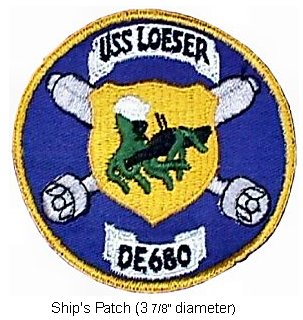
Lt.. Cdr. Arthur Loeser, USS Atlanta and USS Loeser DE680

DE680, the USS Loeser from the deck of the USS Greenwood. 1944.

Arthur Edward Loeser was born 17 April 1906 at Rahway, N.J. He was appointed to the U.S. Naval Academy 15 August 1923, and commissioned ensign 2 June 1927. On 2 September 1941, Lieutenant Commander Loeser reported aboard light cruiser USS ATLANTA (CL-51) as engineering officer. Lieutenant Commander Loeser was killed in action 13 November 1942 when enemy torpedoes crippled USS ATLANTA in the First Naval Battle of Guadalcanal.

http://www.de679.com/0f9ed060.png

An excerpt from the book GUADALCANAL: Decision at Sea by Eric Hammel.

Concerned with his crew of engineers who were sealed below decks in the firerooms and engine rooms, Atlanta's chief engineer, LtCdr Arthur Loeser, had arranged for topside talkers to keep him abreast of what was going on outside while he relayed a running commentary via loudspeakers from his station in the forward engine room. Thus, the engineering staff throughout the cruiser was listening as Lieutenant Commander Loeser described the first seconds of the gunnery exchange - "We're really putting rounds into them!"

Crewmen in blind engineering spaces throughout the ship heard LtCdr Arthur Loeser's mike open once again. Loeser said, "Ah . . ." and the entire world fell in. Loeser's voice was stilled in mid sentence - and forever.

The first Japanese long lance torpedo to find any target struck Atlanta on the port side, nearly amidships and exactly in the center of her forward engine room. In addition to killing virtually everyone on the forward engine room, the detonation blasted a hole in the overhead and killed nearly everyone manning a damage-control station in the crew's mess. The shock of the massive detonation lifted the light cruiser right out of the water...


The USS Atlanta was the lead ship in a class of light cruisers of unique design. They were conceived as flotilla leaders but ushered in a new concept in warship design, the anti-aircraft cruiser, a concept that can still be seen in the navy today in ships specialized for this role. Both ships were sunk in a night surface action in the Naval Battle for Guadalcanal on November 13th, 1942, for which the Atlanta received a Presidential Unit Citation.

FRIDAY NOVEMBER 13th, 1942- one of the most ferocious naval battles ever fought took place off Guadalcanal. Thirteen US ships including,light cruisers Atlanta and Juneau, fought a superior Japanese naval force including two battleships, at close range in what one US naval officer described as a "bar room brawl with the lights shut off"!

The smaller American naval force turned back the Japanese that night and as a result 1,439 US and 520 Japanese sailors gave their lives.

Action Report

Battle Damage

Survivor Stories


USS LOESER DE 680 - Framed Navy Ship Display
Buy a framed USS Loeser

Courtesy of Mike Smolinski

USS Loeser (DE-680)


History of USS Loeser (DE-680)

http://us.st11.yimg.com/us.st.yimg.com/I/priorservice_1960_293666310
Buy the print

Monday, August 06, 2007

Director Builds Center With Imagination, Collaboration

Federal Times: Scott Redd - Imagination, collaboration keys to counterterrorism


Tuesday, July 31, 2007

Lessons Learned from U2 for Leading Worship

The Mercies of God and the Transformed Christian Mind

This series on Romans 12-13--titled The Mercies of God and the Transformed Christian Mind--was given just this past weekend at the Billy Graham Training Center (aka The Cove) in Asheville, NC.

Below are the links to John Piper's full audio presentationalong with notes taken during each session.

Sunday, July 29, 2007

Dog Days

As August nears, the heat is rising on and off the practice field for coaches across the country. Michigan's Lloyd Carr may be one of college football's best but the heat in Ann Arbor is rising with every loss to Ohio State.

Ann Arbor, Mich. (Uncomfortable): Lloyd Carr, one of the most unappreciated coaches in the country, could get the last laugh with a loaded offense and a schedule that brings most of the heavyweight opponents to Michigan Stadium. However, the temperature won't fall in Ann Arbor until Ohio State does.

Buckeyes the blueprint?

I think Michigan is this year's Ohio State. They have arguably the best offense in the country, which includes four possible All-Americans. That's similar or better than what Ohio State had last year.

The Wolverines lost a lot of their defense. The only big differences are that Michigan seems to have better skill players and offensive linemen than last year's Buckeyes. I know Chad Henne is no Troy Smith, but with receivers like (Mario) Manningham and (Adrian) Arrington to throw to he should have a great season. If this is the case, then why aren't the Wolverines rated at least in the top three?

— Ethan in Ann Arbor
-----

The comparison of this year's Michigan to last year's Ohio State is one that's been repeated throughout the offseason, and appears to be legitimate. However, I'm not sure Michigan has better skill players than Ohio State did unless you're comparing Michigan running back Mike Hart to Ohio State's Antonio Pittman - I'd give you that one.

Mike Hart is definitely one of the best in the Big Ten.
However, I think I'd take Ted Ginn Jr. and Anthony Gonzalez as a pair over Manningham and Arrington.

My personal apprehension about Michigan stems from the poor pass defense which was exploited in season-ending losses to Ohio State and Southern California. As you mentioned, that defense is now without CB Leon Hall, DE LaMarr Woodley, DT Alan Branch and LB David Harris, who were all taken in the first two rounds of the NFL Draft.

Can we expect Michigan's defense to be better without them?

However, it did work out when Ohio State lost nine starters - including three first-round draft choices.

Ron English is a sharp defensive coordinator, and there is no reason CB Morgan Trent, S Stevie Brown and DE Tim Jamison can't raise their performance level the way so many Ohio State players did a year ago.

However, they had better do it quickly. Michigan plays Oregon, Notre Dame and Penn State in September. If the defense's problems haven't been ironed out, the Wolverines' national championship hopes could come to a quick end.

That isn't likely, though. We have Michigan fourth in the Rivals.com preseason rankings because of its powerful offense and the fact that most of the Wolverines' marquee games will be played in Ann Arbor.

Michigan #4 in Rivals.com preseason poll

National-championship aspirations are always discussed in Ann Arbor, though not always with as much fervor as this year. The offense is explosive and exciting and the schedule calls for Oregon, Notre Dame, Penn State and Ohio State to visit Michigan Stadium. There are some reasons for apprehension – a rebuilt defense, a new kicker and a road trip to Wisconsin, one of the few teams that can match up with Michigan physically. But overall, the Wolverines are expecting a double-digit victory total and maybe a trip to New Orleans for the BCS national championship game. At the very least, they're counting on reaching the Rose Bowl. Anything less equals disappointment.


Jake Long is a dominant force up front for the Wolverines.


Michigan Schedule
Date Opponent
Sept. 1 Appalachian State
Sept. 8 Oregon
Sept. 15 Notre Dame
Sept. 22 Penn State
Sept. 29 at Northwestern
Oct. 6 Eastern Michigan
Oct. 13 Purdue
Oct. 20 at Illinois
Oct. 27 Minnesota
Nov. 3 at Michigan State
Nov. 10 at Wisconsin
Nov. 17 Ohio State

The truth about RISP

Extreme makeover: Crunching the numbers

Stats: Trade Arroyo, keep Dunn

The case for keeping Adam Dunn